
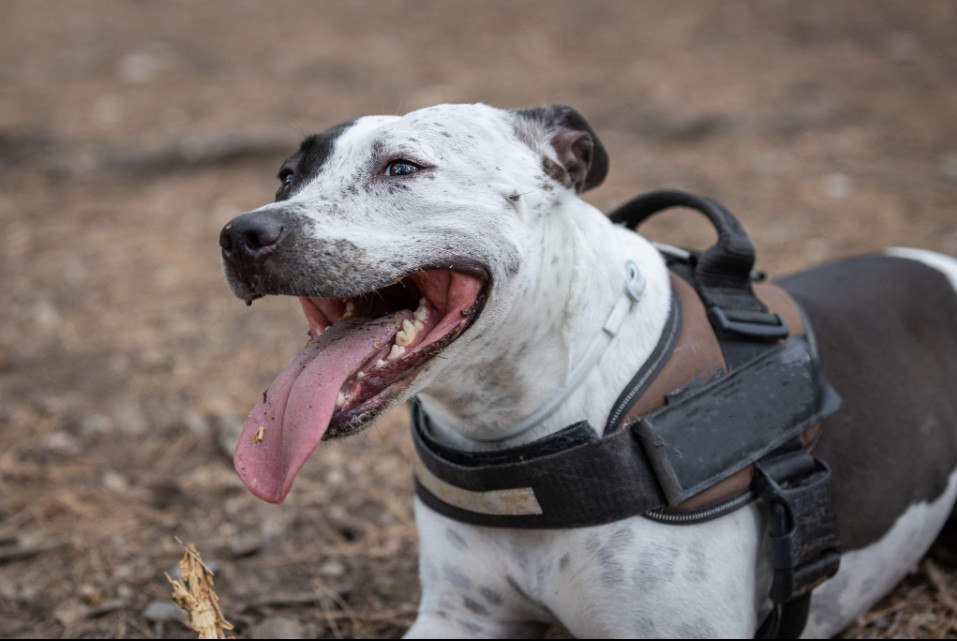
Most dog owners know that hot weather is dangerous. What they do not always know is why heat becomes dangerous so quickly, what is actually happening inside the body when it does, and why so many of the warning signs get missed until it is already an emergency. This blog covers the key evidence from our fully referenced Heat, Humidity and Canine Thermoregulation series, inside The Canine Advocates Community.
The Number That Challenges Everything You Know About Heat Related Illness
16.9°C
Most people assume heatstroke happens in a heatwave, 30°C, maybe 25°C. Certainly not on a mild day in the UK.
Here is something that might shock you….
Among UK dogs presented to vets with heat-related illness, the median ambient temperature on the day they developed heat-related illness was 16.9°C. Median means half of the recorded cases occurred below this value and half occurred above it.
That is not a scorching summer day. It is a condition many owners would consider normal, manageable, or even safe.
That single figure tells you that temperature alone is not the story. If heat-related illness is being seen around conditions many owners would not class as “hot,” then we have to ask a better question.
If it is not just heat, what else is it?
How Your Dog’s Body Actually Manages Heat
Your dog’s body is working constantly to keep its core temperature within a narrow band, roughly 38 to 39.2 degrees Celsius. The body is trying to maintain homeostasis. Step outside that band by even a small margin and the consequences can be serious. A core temperature above 41°C begins to damage tissue. Above 43°C, without rapid intervention, the outcome is often fatal.
The body manages this through four physical mechanisms. Radiation, heat dispersing into cooler surrounding air. Conduction, heat transferring to a cooler surface, which is why dogs lie on tiles. Convection, moving air carrying heat away from the skin. Evaporation. In humans, evaporation means sweating across a large surface area. In dogs, it means panting.
This is the part many people partially know but do not fully understand. Dogs do not regulate temperature through sweat in the way humans do. The glands across their body coat are scent glands, not cooling glands. The only eccrine glands, functionally equivalent to human sweat glands, sit on the paw pads and nose. Their contribution to cooling is negligible compared to the respiratory system. When your dog pants, they are drawing air rapidly across the moist surfaces of the mouth, tongue, nasal passages and upper airways, facilitating evaporation at pace. The thermoregulatory burden sits on that one mechanism.
Which means when panting is compromised, or when the conditions make evaporation less efficient, the system struggles and things can go downhill dramatically and fast.
Why Humidity Is the Hidden Risk Most People Miss
Panting relies on the difference in moisture content between the wet surface of your dog’s airways and the external environmental air passing over them. When the humidity in that surrounding air is already high, that gradient begins to collapse. The environment simply isn’t allowing panting to work efficiently.
Research suggests a relative humidity threshold exists above which the risk of heat-related illness increases meaningfully. This is a directional figure, not a hard cutoff, as other factors always interact, but it illustrates the point clearly.
A dog in 22°C heat at 80% humidity is in a more dangerous position than a dog in 26°C heat at 20% humidity.
Most standard heat advice ignores this entirely.
The combination that causes the fastest deterioration is moderate temperature plus high humidity plus physical exertion. Exercise generates internal heat through muscle activity, independent of environmental conditions. Whether it’s a working dog, a sport dog, or a dog who’s just had a run in the park, they’re managing a dual heat load: external environmental heat and the internal heat produced by metabolic work. Both have to be dissipated through the same mechanism.
There is also a post-exercise lag that many owners are completely unaware of. Core temperature continues to rise for a period after exercise stops, because the muscles are still releasing heat while the body tries to cool. A dog who looks fine the moment they stop running may reach peak core temperature several minutes later. This is when the risk window is highest.
Which Dogs Are Most at Risk
Risk is not equal across all dogs, and understanding the factors that increase vulnerability matters practically. Not because lower-risk dogs are safe, but because higher-risk dogs need proportionally earlier precautions.
Breed
Brachycephalic breeds (flat-faced dogs including Bulldogs, French Bulldogs, Pugs, Boxers) have altered upper airway anatomy that mechanically limits airflow and makes panting less efficient.
Research confirms they are significantly overrepresented in heat-related illness cases.
Body condition
Excess body fat acts as insulation, trapping heat internally.
Research suggests that overweight and obese dogs show earlier signs of thermoregulatory strain during exercise.
This is a manageable risk factor.
Age
Both puppies and older dogs have less efficient thermoregulatory systems. Seniors may also have concurrent health conditions that further reduce heat tolerance.
Neither extreme of the age spectrum should be pushed in warm conditions.
Activity Level
Working dogs, sport dogs (flyball, agility, canicross), and highly active pet dogs are managing internal heat load on top of external heat. Research indicates that post-exercise risk windows extend well beyond the end of activity.
Coat Density
Heavy double coats provide some insulation against radiant heat from above, but they can also trap heat against the body in hot, humid conditions. The relationship is not straightforward, and coat alone does not confer protection.
Previous Heatstroke
Dogs who have experienced heat-related illness before have higher risk of recurrence. The physiological reason for this is not fully understood, but the clinical pattern is consistently observed. Prior heatstroke is never a detail to overlook.
Hidden Risks People Do Not Think About
When people think about heat risk, they tend to picture a dog in a hot car, or a dog exercising on a summer afternoon. Both of those are valid concerns. But the indoor and after-exercise environments carry risk that often goes entirely unacknowledged.
Inside the Home
- A thermostat reading does not tell you what the air is doing in every part of your house. Conservatories can exceed outdoor temperatures substantially through solar gain.
- Upstairs rooms trap rising warm air.
- Crates create micro-environments where airflow is restricted and heat and humidity accumulate.
- Indoor sports halls used for training have no evaporative benefit and may have no ventilation at all.
- Grooming dryers blow hot air directly onto dogs whose coat has already trapped ambient heat.
None of these environments show up in a standard weather forecast.
The practical framework to apply in any indoor environment covers four factors. Temperature, humidity, airflow, and time. A warm room with good airflow and low humidity may be manageable for short periods. A warm room with poor airflow, high humidity, and an extended stay is not.
After Exercise
The post-exercise temperature lag is one of the most consistently underestimated risks in canine heat management. Because the dog looks finished, owners assume recovery is happening. But physiological recovery from a heat load takes time, and the window between stopping exercise and reaching peak core temperature is when many dogs deteriorate. A dog who is panting heavily after a run should not be put straight back in the car. They need genuine cool-down time in a ventilated space before any enclosed environment.
A car is not a cool-down space. Even with windows open, a parked car in warm conditions generates rapid heat accumulation.
The post-exercise dog needs a cool down, moving air, shade, and access to cool water.
Recognising Heat Stress Before It Becomes Heatstroke
This distinction is the one that matters most clinically. Heat stress and heatstroke are not the same thing, and recognising the difference in real time changes the outcome. Heat stress is the body working hard to maintain its temperature. Heatstroke is the point at which that effort has failed and organ-level damage begins. The window between the two is narrow, and in some individuals it can close faster than people expect.
Research consistently shows that owners miss early heat stress signs because those signs look like a tired dog. By the time the signs are obvious, the situation is already advanced.
Signs of heat stress. The body is working hard but has not yet failed. This is your intervention window:
- Panting that seems out of proportion to what has just been asked of the dog
- Panting that does not slow down after rest
- Tongue that appears wider and flatter than usual, or very dark red in colour
- Saliva that is thick or ropy rather than watery
- A dog who seeks shade or lies down and refuses to move
- Restlessness or unusual clinginess
These signs are situation dependent and dog dependent. Know your own dog. If you are seeing anything that feels off for them, move them to a cool, ventilated space, begin cooling, and monitor closely. Do not wait to see if they improve on their own.
Signs of heatstroke. Thermoregulation has failed and organ-level damage is occurring. This is a veterinary emergency. Continue cooling, call your vet immediately and tell them you are on your way.
- Glazed, unfocused expression
- Any wobbling, weakness in the hindquarters, or loss of coordination
- Vomiting or diarrhoea
- Muscle tremors
- Loss of consciousness or collapse
- Seizure
Cool the dog while someone else calls the vet, or call on the way. Do not delay transport waiting for the dog to respond to cooling.
Research classifies heat-related illness from mild through to severe based on clinical signs and outcome. Survival rates of 94.5% in moderate cases drop to 43.2% in severe cases. Those numbers tell you everything you need to know about why catching this early matters.
First Response: What the Science Now Says
This is where a lot of publicly available advice is out of date, and it matters. Current evidence has shifted the guidance on cooling significantly. The detail belongs in a dedicated module, but there is one thing worth saying here clearly because it contradicts advice still widely shared online.
Cold water is not the danger it was once thought to be. Current evidence supports rapid cooling with cold water and, in appropriate situations, immersion in cold water as an effective first response to heatstroke. Cooling should continue while you travel to the vet, not stop when the dog appears more comfortable.
Call your vet immediately so they are ready for you on arrival.
If you have been told to use only tepid water, or to stop cooling once the dog seems better, that advice does not reflect what the research now shows. The full evidence-based cooling guidance, including which methods work, in what order, and how to monitor during cooling, is covered in the Emergency Response module inside The Canine Advocates Community.
What the Evidence Actually Tells Us
Research suggests that the dogs dying from heatstroke in the UK are not exclusively brachycephalic dogs left in cars during heatwaves. They are dogs from a wide range of breeds, with their own individual risk profiles, presenting at a wide range of temperatures, and they are presented to vets too late because their owners did not recognise what was happening until the signs were severe.
Temperature alone is not the rule. Humidity, airflow, your individual dog’s breed, anatomy, body condition, age, activity and fitness level all matter. Learning to recognise the difference between a dog who is working hard and a dog whose system is starting to fail is something every owner must do.
The Bottom LineThe best thing you can do this summer is learn your dog’s baseline. Know what their normal panting looks like, sounds like, and how long it typically takes them to settle after exercise. That baseline is your reference point. Anything that falls outside it deserves your attention.
Newsletter
Call Or Text for more information
Copyright © 2026 Born to Run. All Rights Reserved. Privacy | Terms & Conditions